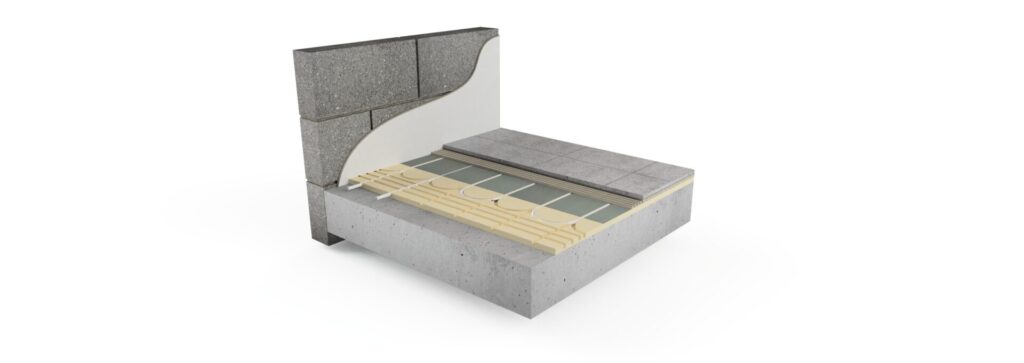
Liquid Screed: Level up your underfloor heating.

When it comes to underfloor heating installation, choosing the right screed is crucial to maximising efficiency and achieving a flawless finish. While traditional sand and cement screeds have their place, liquid screed emerges as a strong contender for modern underfloor heating installations.

Advantages of liquid screed for underfloor heating:
  • Reduce Depth: Traditional screeds require a minimum of 65mm depth. Liquid screed excels with a thinner profile – typically around 50mm when used with underfloor heating. This translates to quicker heat response and improved system efficiency.
  • Superior Thermal Conductivity: Liquid screed boasts better heat transfer properties compared to traditional options. This allows for faster heat distribution and lower energy consumption, leading to cost savings.
  • Self-levelling: No manual screening is needed to ensure a level surface for the final floor covering. This saves labour time and guarantees a professional finish.
  • Faster drying times: Liquid screed dries significantly faster than traditional screeds, allowing you to move on to the next stage of the project quickly.
  • Reduced cracking risk: Because of its self-levelling nature and minimal shrinkage, liquid screeds offer a lower risk of cracking than traditional screeds.
Considerations for Choosing Liquid screed:
  • Floor insulation: To prevent adverse reactions, ensure the insulation board used is compatible with the chosen liquid screed.
  • Drying process: Discuss drying methods. While some liquid screeds air dry, others benefit from forced drying techniques like dehumidifiers.
  • Subfloor preparation: The subfloor needs to be properly prepared before applying liquid screed. This includes ensuring a clean, level and sound surface.
Looking for a one-stop shop for underfloor heating excellence?

At UFHN we understand the importance of a seamless underfloor heating project. That’s why we offer a comprehensive all-in-one package that includes everything you need, from high-quality screed to pipe, insulation, manifolds and more.

UFHN supplies only the best quality products and expert guidance. Our team is here to answer your technical questions and get all your necessities in one place, simplifying your project planning.

For a free consultation, call 01202 894976 or email sales@ufhn.co.uk

Delivering warmth for a RIBA winner.

We’re excited to share some wonderful news from UFHN! One of our recent projects, where we designed, supplied, and installed an underfloor heating system, has received fantastic recognition for its beautiful design.

This gorgeous property, featuring our Mercury Atlas system, has won the RIBA South East Award for 2024 and is now on the shortlist for the highly sought-after RIBA House of the Year award!

The Mercury-Atlas system is a favourite for screed floors because it’s quick to install and super flexible. Our 16mm Mercury pipe is neatly clipped to insulation and provides amazing output, especially for the lovely tiled floors of Eavesdrop.

We’re so proud to have played a part in creating such a stunning space that offers beauty, incredible comfort, and energy efficiency for its owners.

Check out the clip below to see why this property has caught everyone’s attention!

Traditional screed: A solid foundation for your underfloor heating project.

When it comes to underfloor heating, choosing the right screed is crucial for optimal heat distribution and system efficiency. While modern options like liquid screed exist, traditional sand and cement screed remains a popular and reliable option. Let’s explore the advantages and considerations of using traditional screed for your next underfloor heating project.

Advantages of Traditional Screed for Underfloor Heating:
  • Cost effective: Traditional screed is generally more affordable, making it a budget-friendly option for most projects, especially where large areas are involved.
  • Proven performance: This time-tested method has a long history of successful applications with underfloor heating systems, ensuring reliable heat distribution. Our most popular floor constructions are screed-based systems!
  • Readily available: Unlike liquid screed which often requires pre-ordering, traditional screed is readily available making it a convenient option for contractors.
  • Durable: Once cured, traditional screed offers excellent strength and durability and can handle heavier loads, creating a solid base for your flooring.
  • Uneven subfloors: Traditional screed can be used to level out larger irregularities in the subfloor, whereas liquid screed is more suitable for smaller imperfections.
Considerations for using Traditional Screed:
  • Drying time: Traditional screed requires a longer drying time compared to liquid screed (typically 5-7 days). This can impact your project timeline.
  • Mixing and laying: Mixing and laying is labour intensive and requires professional installation for a good finish.
  • Weight: Traditional screed is heavier than liquid screed so consider weight limitations on upper floors
  • Potential for cracking: While modern additives can minimise risk, there’s a slightly higher chance of cracking compared to liquid screed.
UFHN, your all-in-one floor package partner.

At UFHN, we understand the importance of a well-executed underfloor heating project. We offer a comprehensive all-in-one floor package that includes everything you need from design, supply and installation of systems, screed and insulation. Our experienced team can guide you through the process and help you choose the right screed option for your project.

Ready to start your underfloor heating journey? Contact us today for a free consultation.

UFHN: 20 years of warmth and innovation.

In 2004, UFHN embarked on a mission to redefine home comfort. We challenged traditional forms of heating, recognising the limitations of radiators and offering more efficient, discreet and comfortable solutions.

Over the past twenty years, we’ve honed our expertise in underfloor heating design, supply and installation, collaborating with a diverse clientele from renowned architects and developers to local authorities and homeowners. Our dedication to customer-centric solutions has earned us industry accolades and solidified our position as leaders in the field, particularly in historic building restoration and unique projects across the UK.

Our comprehensive range of heating solutions has evolved to encompass traditional warm water systems, electric underfloor heating mats and cutting-edge air source heat pumps. Our extensive stock of over £0.5M worth of materials, coupled with our fleet of delivery vehicles ensures timely and efficient project execution. Additionally, our team of highly skilled CSCS Certified installers is the largest directly employed force of its kind in the UK.

As the UK moves towards a greener future and implementation of the Future Homes Standard, underfloor heating is becoming the standard for efficient and sustainable heating solutions. UFHN is committed to providing innovative solutions that continue to set new standards for comfort and efficiency.

Paul Lines, UFHN Managing Director comments, “Twenty years ago underfloor heating was a niche product. Today it’s a recognised solution for a more comfortable and sustainable home. Our team have demonstrated an unwavering commitment to exceeding customer expectations which has been instrumental to our success and I couldn’t be prouder. Our success is testament to their hard work and the trust our customers have placed in us. As we look to the future, we remain committed to providing innovative solutions that continue to set new standards in modern heating technology”.

To find out more visit www.ufhn.co.uk or if you’d like us to quote on your next underfloor heating project please get in touch.

Choosing the right screed for your underfloor heating project.

Underfloor heating promises a luxurious and energy-efficient way to warm a home. But did you know the type of screed you choose can significantly impact its performance and installation process?

When it comes to flooring installation, the choice between traditional screed and liquid screed can be a tough one. Both methods have their own set of advantages and disadvantages, and the best choice for your project will depend on a variety of factors. In this blog post, we’ll explore the key differences between these two methods and help you decide which one is the right fit for your needs.

Understanding Screed:

Screed is the base layer applied over and around the underfloor heating pipes, creating a smooth and even surface for the final flooring. It is crucial in ensuring efficient heat distribution, reducing installation time and overall client satisfaction.

The two main contenders: Traditional vs Liquid Screed.
Traditional Screed:

Traditional screed, also known as sand and cement screed is a tried-and-tested method that has been used for many years. It involves mixing sand and cement with water to create a mortar and then applied to the floor. Once the screed has been applied, it is levelled and allowed to dry completely before the final flooring can be installed.

Advantages:
  • Cost effective: Traditional screed is generally a more affordable option than liquid screed.
  • Durable: Long lasting due to its robust nature. The cement binds the sand particles together, creating a strong, durable surface that can withstand heavy loads and foot traffic. Additionally, it is resistant to moisture and temperature fluctuations, making it suitable for various environments.
Disadvantages:
  • Time consuming: The drying time for traditional screed can be quite long, which can delay the overall project timeline.
  • Labour intensive: The sand and cement mixture is typically mixed manually on site and levelled using tools like trowels with are time consuming.
  • Prone to cracking: Traditional screed can be prone to cracking, especially in larger areas.
Liquid Screed

Liquid screed is a more modern flooring solution that involves a self levelling cement based mixture. It is applied to the floor in a liquid form and then self-levels to create a smooth, even surface. Liquid screed dries much faster than traditional screed and can be ready for flooring installation within a few days.

Advantages:
  • Fast drying time: Liquid screed dries much faster than traditional screed, which can significantly reduce project timelines.
  • Smooth finish: It provides a smooth, even finish that is ideal for a variety of floor types including tiles, wood and carpet.
  • Reduced labour costs: The application cost is less labour intensive than traditional screed.
Disadvantages:
  • Higher cost: Liquid screed is generally more expensive than traditional screed.
  • Requires skilled installation: The application process requires skilled installers to ensure a successful outcome.
Which is right for you?

The best choice for your project will depend on a number of factors, including:

  • Budget: If you’re on a tight budget, traditional screed may be the more affordable option
  • Timeframe: If you need a fast turnaround, liquid screed is the way to go.
  • Desired finish: If you want a smooth, even finish, liquid screed is the better choice.
  • Subfloor condition: The condition of your subfloor will also impact the best choice of screed.
By partnering with UFHN, you can streamline your underfloor heating project and benefit from an all-in-one heating package. Our services include:
  • Expert Consultation: Our team of professionals can provide tailored advice to help you select the most suitable screed solution for your project.
  • High quality products: We are proud to supply Mercury underfloor heating systems and accessories to ensure optimal performance and reliability. Our screed compatible systems are highly sought after and specified in hundreds of projects.
  • Complete Installations: Our skilled technicians can handle all aspects of the installation process.

Contact us today to learn more about our award-winning solutions and how we can support you with your next project.

How underfloor heating is paving the way for the Future Homes Standard.

The way we build and heat our homes is changing. The UK’s Future Homes Standard is setting ambitious targets for energy efficiency and a significant reduction in carbon emissions. This landmark legislation mandates a shift from traditional gas boilers towards sustainable solutions like air source heat pumps and underfloor heating.

What is the Future Homes Standard?

The Future Homes Standard aims to make all newly built homes ‘net zero ready’. This means they should have minimal energy needs and be prepared for a future powered by renewable energy sources.

Key aspects of the standard include:

  • Significantly lower CO2 emissions: New homes will need a 75-80% reduction in carbon emissions compared to current building regulations.
  • Phase out fossil fuel heating: The use of traditional gas boilers is significantly restricted, paving the way for zero-carbon heating alternatives like air source heat pumps.
  • High energy efficient construction: Improved insulation and airtightness will ensure minimal heat loss.
Underfloor Heating and Air Source Heat pumps: A perfect pair

Underfloor heating and air source heat pumps are ideal partners for achieving the goals of the Future Homes Standard. Here’s why…

  • UFH thrives on lower temperatures: UFH operates at much lower water temperatures than traditional radiators. This aligns perfectly with the low-temperature outputs of ASHP’s, maximising efficiency and minimising energy consumption.
  • Radiant comfort: UFH provides a gentle, even heat that warms the home from the ground up, creating a more comfortable living environment
  • Enhanced energy efficiency: When combined with a well-insulated home, UFH and ASHP’s create an exceptionally energy-efficient heating system, significantly reducing energy bills and minimising environmental impact.
Underfloor Heating Experts: Your transition partner

Navigating the complexities of the Future Homes Standard can be challenging. UFHN’s underfloor heating and air source heat pump specialists are perfectly positioned to help you navigate the Future Homes Standard transition. We offer a comprehensive service, including:

  • Expert Advice: Our team provides free consultations and will recommend the most suitable UFH & ASHP combination for your project.
  • Future Homes Standard Compliance: We ensure the heating system meets all the requirements of the Future Homes Standard, contributing to a more sustainable and energy-efficient home.
  • Seamless installation: Our experienced engineers will take care of everything, from design and planning to installation and aftercare.
Embrace the future of heating.

The Future Homes Standard marks a significant step towards a more sustainable future for home heating. Underfloor heating and air source heat pumps are key players in this transition, and UFHN is your partner in creating a comfortable, energy-efficient home for years to come.

Contact the team today and explore how we can help you embrace a future-proof heating solution.

UFHN Proud to sponsor Bournemouth Electric Youth U14 Team.

UFHN is excited to announce its sponsorship of the Bournemouth Electric Youth U14 Lightning team for the next two years. As a dedicated supporter of local talent development, UFHN is committed to fostering the growth of promising young athletes.

The U14 Lightning team, a top-tier competitor in Bournemouth Youth League has had a strong start to the season, with one win and one loss in their two league games. They also participated in the Hampshire Cup on the weekend winning their first match with an impressive 12-1 victory. They are also competing in the Bournemouth Challenge Cup.

Many of the boys on the team play Saturday league football through the Junior Premier League. Several players are also part of development centre’s for professional clubs like Bournemouth and Southampton. “We’re thrilled to support Bournemouth Youth U14 Lightning Team”, said Paul Lines, Managing Director. “These young players are incredibly talented and dedicated, and we’re proud to be part of their journey. We believe in the importance of supporting local talent and providing opportunities for these athletes to develop their skills”.

The Lightning Team is grateful for UFHN’s sponsorship and looks forward to a successful season.

Bournemouth Electric Youth U14’s.

Maximise space with low profile underfloor heating.

Underfloor heating is a luxurious and efficient way to warm a property, but traditional systems can add significant height to the floor. This can be a problem in renovations or situations with limited floor-to-ceiling space. Thankfully, technological advancements have brought low profile underfloor heating systems, offering all the benefits of underfloor heating with a minimal increase in floor height.

Advantages of Low Profile underfloor heating:
  • Suitable for renovations: Low profile underfloor heating systems are perfect for existing floors where raising the floor level significantly isn’t an option.
  • Faster installation: These systems often utilise dry construction methods, allowing for quicker installation and less construction.
  • Compatible with various floor coverings: Low profile underfloor heating systems work well with a wide range of floor coverings, including wood, laminate, vinyl and even some types of carpet.
How Low can you go?

The exact profile of a system is dependent on the specific product, but our systems can add as little as 15mm to 18mm to the existing floor height. This makes them ideal for projects with even the most restricted space limitations.

Which rooms are low-profile underfloor heating systems best suited for?

Low profile underfloor heating systems are particularly well-suited for rooms where space is at a premium or where renovations require minimal disruption. Here are some prime examples:

Renovation Projects
  • Period properties: Maintaining original floor heights is crucial in period homes. Low profile systems are perfect for preserving the character of these properties. We’ve completed many listed and period properties, view the case studies here.
  • Apartments and flats: Space is often limited, making low profile systems an excellent choice.
Specific Rooms
  • Bathrooms and ensuites: While traditional underfloor heating is popular here, low profile systems offer a stylish alternative without compromising comfort.
  • Kitchens: Combining underfloor heating with modern kitchen design creates a sleek and warm environment.
  • Conservatories and extensions: These spaces can be challenging to heat efficiently. Low profile systems can offer a discreet and effective solution.
  • Bedrooms: Enjoy the luxury of stepping onto a warm floor when you first get out of bed.

Choosing the right system for your needs:

With various low profile systems available, selecting the right one for your project requires careful consideration. It’s essential to consider several factors before installation:

Floor Preparation
  • Level Surface: The subfloor must be flat and level for optimal heat distribution. Any uneven surface can impact system performance.
  • Insulation: Proper insulation is crucial to prevent heat loss and ensure efficient operation. The type of insulation will depend on the floor structure and desired heat output.
  • Moisture control: Ensure the subfloor is dry to prevent damage to the system and potential mold growth.

Floor Finish

Not all floor finishes are suitable for low profile underfloor heating. Some materials like thick carpets can hinder heat transfer and will affect how quickly the heat reaches the room. Thinner finishes tend to be more efficient. Materials with good thermal conductivity, such as stone or ceramic tiles can enhance heat distribution.

Consult with the specialists

Consulting with underfloor heating specialists such as ourselves can be invaluable. We offer a comprehensive range of low profile underfloor heating systems and can help you design, supply and install the perfect solution. Our expertise ensures you get the most efficient heating solution with minimal impact on the existing floor level.

As part of our system design, we will calculate the required heat output based on room size, insulation and desired temperature and a pipe layout that is carefully planned to ensure even heat distribution. The final piece of the puzzle is a suitable control system to regulate temperature and optimise energy efficiency.

Low profile underfloor heating systems remove a major barrier to enjoying the benefits of underfloor heating. Don’t let limited floor space hold you back from considering underfloor heating in your next project.

To discuss your next low-profile underfloor heating project send in your plans, call us on 01202 894976 or visit www.ufhn.co.uk

Revolutionise your underfloor heating installations with Stella Cement.

The new Mercury Stella Cement system will tick many boxes if you want a more efficient and effective underfloor heating solution. This cutting-edge, low-profile, cement-coated insulated board is designed to streamline the installation process, saving time on programme and budget.

Crafted from high-density extruded polystyrene and boasting a slim profile of 16mm or 20mm, the pre-routed board can support a variety of flooring materials making it adaptable to diverse project needs and can be laid over existing floors.

Key Benefits:

  • Faster Installations: Stella Cement’s user-friendly design accelerates project timelines. Pre-routed channels speed up pipe installation.
  • Versatility: Designed for direct bonding of floor tiles and compatible with floor finishes such as wood, LVT and carpet, subject to additional floor preparation.
  • Moisture Resistance: Well suited for use in bathrooms and other moisture-prone areas.
  • Cost effective: Reduces labour costs and material waste by eliminating the need for additional subfloor or complex layouts.
  • Low Profile: Designed for use on existing floors or spaces where floor height is crucial.
  • Complete Solution: UFHN offers a comprehensive service from design, supply and installation

Why choose Stella Cement?

By partnering with us, you can focus on your core competencies while we handle the intricacies of underfloor heating. Our expert team provides complete design, supply and installation services, ensuring a seamless process from start to finish.

Whether you’re tackling a new build or a complex renovation, Stella Cement offers the perfect solution. Its exceptional performance, coupled with our comprehensive support, makes it the ideal choice for project managers seeking a reliable and efficient underfloor heating system.

Ready to experience the difference?

Stella Cement presents a revolutionary approach to underfloor heating for renovations. With its ease of installation, low-profile design and versatility, Stella Cement is fast becoming the go-to system for solid floors. For more information contact us on 01202 894976 or send in your plans for a free no-obligation quote.

Underfloor Heating at Waterfront Development.

We’re delighted to announce our involvement in the prestigious Waterfront Development on Poole Quay for London Land Group. Our team are currently installing a Mercury Aurora castellated panel system across all 291 apartments, spanning an impressive 17,000 square meters.

Contract Manager Craig Davis highlights the project’s scope and progress stating, “We began the underfloor heating installation six weeks ago and are making excellent headway. We’ve completed two blocks so far and are about to install our 55th manifold and while there’s more to be done, I’m confident we’ll continue in this momentum”.

The Aurora system offers superior heat distribution and energy efficiency, ensuring optimal comfort for residents while minimising running costs. This aligns perfectly with the vision of the Waterfront project, aiming to provide luxurious and sustainable living spaces in an enviable location. This underfloor heating system is designed for a fast and accurate install where castellated panels interlock to create an easy fixing system for Mercury 16mm pipe without clips or staples. This floor system is commonly used as part of a specified acoustic floor detail within flats and houses.

The apartments will be arranged across five buildings, reaching 11 storeys high with the design taking inspiration from the rich maritime heritage from the surrounding area. London Land has been incredibly accommodating throughout the project’s initial stages, Davis adds. “Their collaborative approach is invaluable for ensuring a smooth and successful installation”.

For further information on Mercury Aurora or any other project, please contact us.